
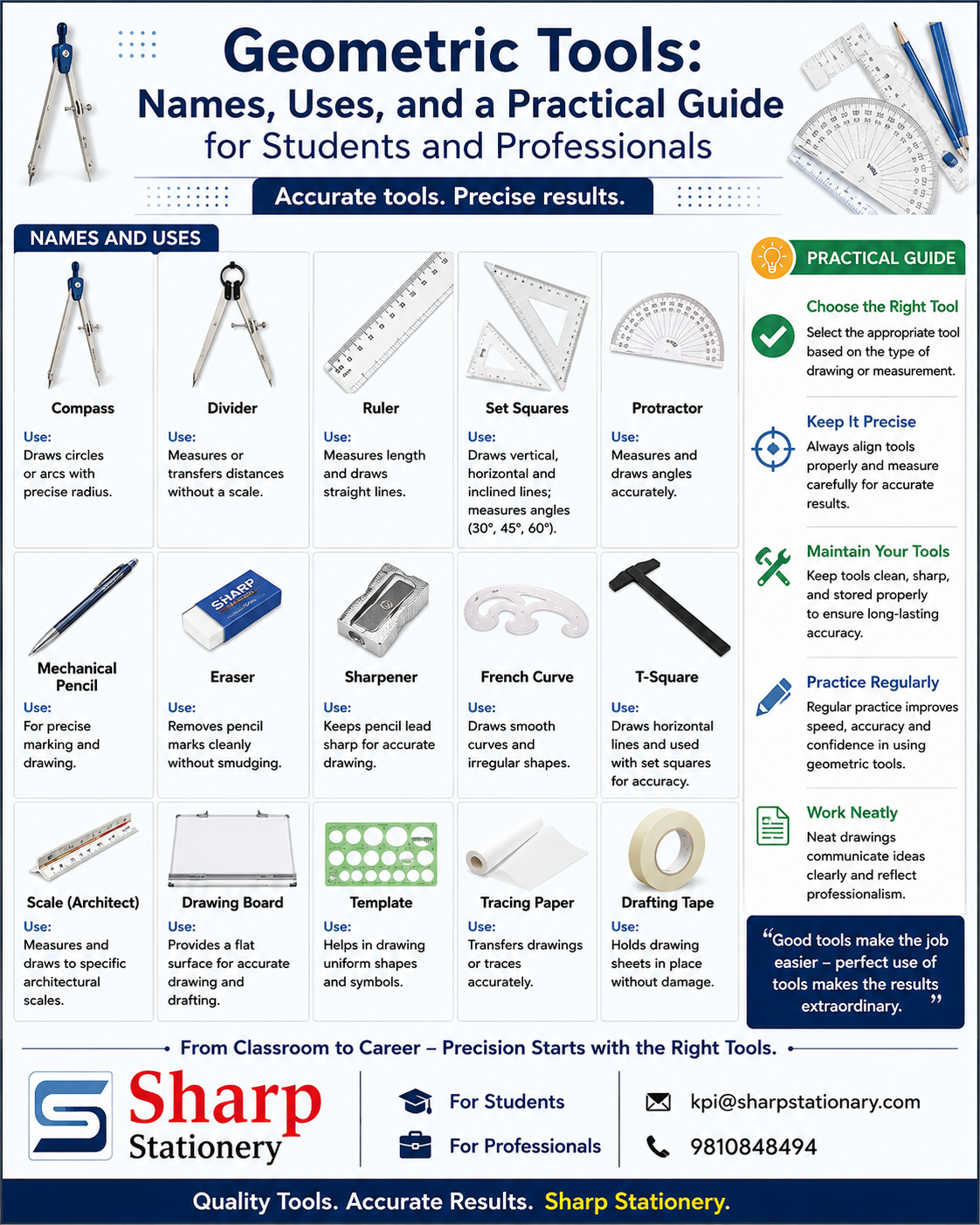
Geometric Tools: Names, Uses, and a Practical Guide for Students and Professionals
Ever stood before a wall of tools and wondered why each one carries its own unique name? Whether you’re a student cramming for geometry exams, a hobbyist sketching a new design, or a civil engineer drafting a bridge, knowing the right geometric tools and how to use them can make all the difference. This post – “Geometric box Tools: Names, Uses, and Practical Guide” – dives into the world of measurement tools, construction instruments, and drafting equipment, giving you the knowledge and confidence to choose and use them effectively.
The Alphabet of Geometry Tools
Geometric tools have been around for centuries, evolving from simple straightedges to sophisticated digital gadgets. Below is a quick reference of the most common tools, their full names, and what they’re best for.
Straightedge & Ruler
-
Name: Straightedge or ruler (often a 12-inch or 30-cm metal piece).
-
Use: Provides a true straight line; ideal for drawing horizontal or vertical lines in drafting and design.
Compasses
-
Name: Compass (the pair of legs with a pivot point).
-
Use: Draws circles, arcs, and helps in creating equidistant points.
-
Tip: Keep the leg with the pencil soft for cleaner lines.
Protractor
-
Name: Protractor (graduated angle measuring instrument).
-
Use: Measures and constructs angles up to 180°.
Set Squares
-
Name: Set square (right-angle, 30-60-90, or 45-45-90).
-
Use: Ensures perpendicular or obtuse angles in technical drawing.
Dividers
-
Name: Dividers (two similar jaws).
-
Use: Transfers distances from one part of a drawing to another, useful in drafting circles or arcs.
Calipers
-
Name: Calipers (digital or dial).
-
Use: Precise measurement of internal and external dimensions, crucial in engineering.
Drawing Board & T-Board
-
Name: T-board or drafting table.
-
Use: Provides a stable surface and adjustable angle for drawing.
Scale Rulers
-
Name: Scale ruler (graduated in various units).
-
Use: Translates real-world dimensions to a scaled drawing.
How These Tools Are Used in the Real World
While the names may sound academic, each tool has a tangible purpose in everyday tasks. Below are a few practical scenarios that highlight the importance of selecting the right instrument.
Architecture & Construction
-
Set Squares & Protractors help architects maintain precise angles on blueprint drafts.
-
Calipers ensure that structural components fit together exactly, avoiding costly adjustments on site.
Mechanical Engineering
-
Dividers transfer critical distances between parts of machinery.
-
Scale Rulers allow engineers to produce accurate schematics that scale down to a 1:50 or 1:100 ratio.
Graphic Design & Illustration
-
Straightedges are used in overlaying digital layers to maintain alignment.
-
Compasses help in creating symmetrical designs for logos and patterns.
DIY & Home Improvement
-
A protractor paired with a measuring tape can spot the exact angle needed for a new shelf.
-
Calipers can check the thickness of wood to ensure a snug fit.
A Practical Guide to Selecting the Right Tool
Choosing the right geometric tool isn’t just about naming it correctly; it’s about matching the tool’s strengths to the task at hand. Follow this practical checklist to ensure you never miss a beat.
-
Define the Task
-
Is it a measurement, a construction line, or a curved shape?
-
Example: If you’re drafting a floor plan, a set square and straightedge will be essential.
-
-
Consider Scale and Precision
-
A large-scale project may need a digital caliper for millimeter accuracy.
-
Small scale sketches can work with a simple ruler.
-
-
Check Tool Quality
-
Look for hardened steel edges on a straightedge; this reduces wear and extends lifespan.
-
Digital calipers should have a resolution of at least 0.01 mm.
-
-
Assess Portability
-
For frequent travel, compact tools like a pocket protractor or a traveling set square are ideal.
-
-
Budget Wisely
-
While high-end drafting tablets exist, a reliable set of mechanical tools can serve a beginner for decades.
-
Tips & Tricks for Mastering Your Geometric Tools
Even the best tools can fall short without proper technique. Here are proven strategies to elevate your drafting and measuring game.
Master the Straightedge
-
Align carefully: Place the straightedge on a clean surface and press gently to avoid warping.
-
Use a dot pen: For long lines, a dot pen placed at regular intervals helps you keep your hand steady.
Get Comfortable with the Compass
-
Lock the leg: When drawing arcs, lock the compass leg to prevent accidental widening.
-
Test first: Draw a small test arc on scrap paper to verify radius before committing to the main drawing.
Calipers: The Unsung Hero
-
Zero it out: Always zero the caliper before measuring to avoid cumulative error.
-
Use the jaws wisely: For internal measurements, use the small jaws; for external, the large ones.
Digital vs. Analog
-
Digital tools provide instant readings and memory functions but can be expensive.
-
Analog tools excel in durability and are beloved by those who appreciate tactile feedback.
Real-World Success Stories
Sometimes seeing others succeed is the best motivation for learning.
-
John, a civil engineering student, used a set of calibrated compasses to draft a bridge layout that was accepted with a 98% accuracy rating.
-
Maria, a freelance illustrator, swapped a bulky drafting table for a lightweight T-board, saving her studio space and still maintaining precision in her sketches.
-
Rahul, a hobbyist woodworker, purchased a pair of digital calipers for just $50 and instantly improved the fit of his custom furniture pieces.
These stories illustrate that with the right tools and a bit of practice, anyone can refine their craft.
Common Mistakes to Avoid
Even seasoned users can fall into pitfalls that degrade accuracy. Keep these in mind to maintain your edge.
-
Skipping calibration: Not checking your instruments before use leads to compounding errors.
-
Using the wrong unit: A ruler marked in inches for a metric project creates confusion.
-
Ignoring tool maintenance: Dust and debris on a compass can blur lines; clean regularly.
Conclusion: Your Next Step
Now that you’ve unpacked the “Geometric Tools: Names, Uses, and Practical Guide,” you’re equipped to make smarter tool choices in everything from architecture to art. Remember:
-
Start with a clear purpose.
-
Match the tool’s capabilities to your task.
-
Practice, practice, practice.
Take action today: Grab a basic set of drafting tools—ruler, compasses, protractor, and a digital caliper—and test them on a small project. Observe the difference in precision and satisfaction. Share your results in the comments or on social media; we’d love to hear your journey!



Leave a reply